
Whisky vs Whiskey: Why the Spelling Changes and What It Tells You About the Bottle
Whisky is the spelling used in Scotland, Canada, Japan and India; whiskey is how Ireland and the United States spell it. On its own, the extra e changes nothing in the glass, but it does point to the country, and the country’s rules decide the style inside the bottle.
Our whisky shelf carries both spellings, and our full guide to Scotch whisky in Malaysia covers the regions in more depth; this piece focuses on the spelling rule itself, the exceptions that trip up confident drinkers, and which bottles on our own shelf carry which spelling. Order before 2PM and we can get a bottle to your door in the Klang Valley the same day.
Key Takeaways
- Whisky is the spelling used in Scotland, Canada, Japan and India; whiskey is used in Ireland and the United States, with a handful of American exceptions.
- The spelling alone changes nothing in the glass; the country’s production rules, grain, still type and cask, decide the style.
- Scotch whisky must be distilled and matured in Scotland for a minimum of three years at no less than 40% ABV, across five legally protected regions.
- Malaysia’s own Timah is a local whiskey, spelled with the e, sitting alongside the big international names on our shelf.
- We stock both spellings across the range, sourced from authorised distributors, with same-day delivery in the Klang Valley on orders before 2PM.
In This Guide
The Simple Spelling Rule Behind Every Bottle
The rule sounds fussy until you see the pattern: countries whose own name for the spirit has an e in it, Ireland and the United States, spell it whiskey. Everyone else, Scotland, Canada, Japan and India, drops the e and spells it whisky. It is a small memory trick, but it holds up almost every time you check a label.
The spelling is not just a style choice either; the U.S. federal rules that govern labelling actually say the word may be spelled as either whisky or whiskey, so American producers get to pick, and a few well-known ones, George Dickel, Maker’s Mark and Old Forester, all choose whisky. Shiok as that sounds for trivia night, the exception proves the rule holds everywhere else, what is printed on the label almost always tracks back to where the spirit was actually made.
Whisky vs Whiskey Compared Country by Country
Once you know the country, you can predict most of what is in the bottle. Here is how the main whisky and whiskey producing countries line up on grain, distillation and minimum ageing, including where bourbon and Scotch actually part ways.
| Country | Spelling | Main grain | Distillation | Minimum ageing | Typical taste | A bottle on our shelf |
|---|---|---|---|---|---|---|
| Scotland | Whisky | Malted barley (or grain) | Pot or column still | 3 years, oak casks | Smoky to fruity, region-dependent | Johnnie Walker Black Label |
| Ireland | Whiskey | Malted & unmalted barley | Often triple distilled | 3 years, wood | Smooth, light, gently spiced | Jameson |
| United States (Bourbon) | Whiskey (usually) | 51%+ corn | Column still | No minimum (2 yrs for straight) | Sweet, vanilla, caramel | Bourbon-family bottles |
| United States (Tennessee) | Whiskey | 51%+ corn, charcoal-mellowed | Column still | 2 years as straight | Sweet with a smoky edge | Jack Daniel’s Old No. 7 |
| Japan | Whisky | Malted barley or grain | Pot or column still | No fixed legal minimum | Delicate, precise, often floral | Suntory Toki |
| Canada | Whisky | Rye, corn or wheat blends | Column still | 3 years, small wood | Light, smooth, easy-drinking | Imported blends |
| India | Whisky | Often molasses-based or grain | Column still | Varies by producer | Ranges from sweet to robust | Imported blends |
| Malaysia (Timah) | Whiskey | Grain, locally produced | Column still | Producer-stated | Approachable, everyday sipping | Featured in our Timah guide |
Does the Spelling Change the Taste?
No, not by itself. Two bottles can carry the exact same spelling and taste nothing alike, because the letter on the label never touches the grain bill, the still, the cask or the climate the spirit ages in. Those four variables do all the real work.
Think of it this way: a Speyside single malt and a Tennessee whiskey are both aged in oak, but one leans honeyed and orchard-fruited while the other leans sweet with a smoky edge from the charcoal mellowing step. Same idea, oak-aged grain spirit, completely different result, and the spelling on each label tells you almost nothing about which one you are about to pour.
What a Scotch Whisky Region Tells You
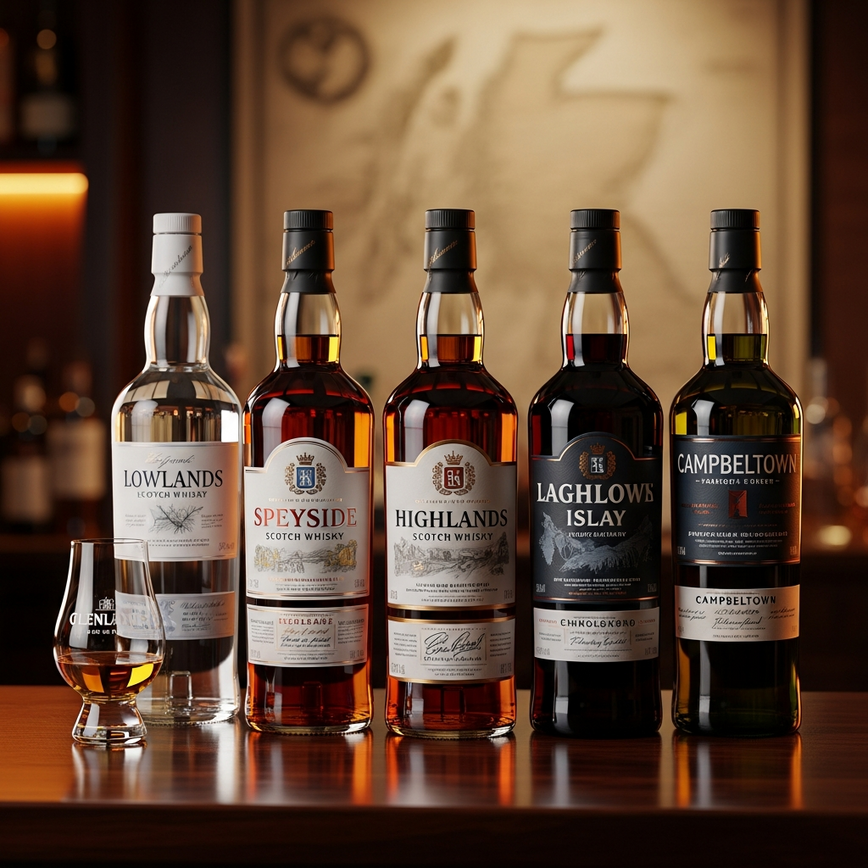
Scotch carries an extra layer most whisky does not: the region on the label is a legally protected term, not marketing copy. The UK’s own Scotch Whisky Regulations name five protected regions, and each one leans toward a recognisable house style, steady enough that you can shop by region once you know your own taste. We go a lot deeper on this in our regions explainer, but here is the short version.
| Region | General character | Good starting point |
|---|---|---|
| Speyside | Elegant, often fruity or honeyed | Most single malts on our shelf |
| Highland | Broad range, from light to bold | A safe first single malt |
| Lowland | Light, gentle, easy on new drinkers | A softer introduction to single malt |
| Islay | Smoky, peaty, coastal | For drinkers who already like bold flavours |
| Campbeltown | Small region, briny and full-bodied | Worth seeking out once you know your taste |
The American Exceptions That Confuse Everyone
Just when the rule feels solid, a handful of exceptions show up. A few American producers, George Dickel, Maker’s Mark and Old Forester, print whisky on the label even though they are made in the United States, simply because U.S. rules allow either spelling. Jack Daniel’s is the opposite kind of exception: it is whiskey, and specifically Tennessee whiskey, not bourbon, because it goes through an extra charcoal-mellowing step, the Lincoln County Process, before it ever touches a barrel.
Japan is its own case. Japanese producers write whisky on the label, following Scotland’s convention, and since 2021 an industry standard defines what “Japanese whisky” actually means, water, mashing, fermentation, distillation and ageing all done in Japan. We compare the two styles properly in our Japanese whisky vs Scotch guide. Malaysia’s own Timah sits on the other side of the line: it is a local product, and it is labelled whiskey.
If terms like single malt, blended, or straight still feel like a different language, our full whisky types guide breaks each one down so the label actually makes sense the next time you’re browsing our shelf.
Which Spelling Malaysians Actually Buy Most Often
Numbers aside, here is what actually moves off our shelf, one bottle for each of the main spelling families, so you can see the rule in practice rather than on a page.
Jameson Triple Distilled Irish Whiskey
Start with the classic whiskey side of the shelf. Jameson is Irish whiskey through and through, triple distilled for a smoothness that new whiskey drinkers tend to reach for first.
![Jameson triple distilled irish whiskey [700ml] available at mr. Chow malaysia](https://shopmrchow.com/wp-content/uploads/2025/07/wp-image-mrchowliquorstore-661.jpg)
A bottle of Jameson Triple Distilled Irish Whiskey (RM125.00) is one of our steadiest sellers precisely because it is forgiving, neat, on ice, or mixed into a simple highball all work without a fuss. You can also browse the full Jameson range if 700ml is not the size you need.
Tasting Notes: Jameson Irish Whiskey
Nose: Light, floral, a touch of vanilla
Palate: Smooth, gently spiced, sweet fruit
Finish: Short, warm, easy
Jack Daniel’s Old No. 7 Tennessee Whisky
On the American whiskey side, Jack Daniel’s tells its own story. It is labelled Tennessee whiskey rather than bourbon precisely because of that charcoal-mellowing step we mentioned earlier.
![Jack daniel's old no. 7 tennessee whisky [1000ml] available at mr. Chow malaysia](https://shopmrchow.com/wp-content/uploads/2025/07/wp-image-mrchowliquorstore-2461.jpg)
The Jack Daniel’s Old No. 7 Tennessee Whisky (RM146.00) carries that signature sweet, smoky character straight through into the glass, whether you drink it neat or build it into a classic whiskey sour. Boleh tahan for a bottle that has stayed this consistent for so long.
Tasting Notes: Jack Daniel’s Old No. 7
Nose: Charred oak, caramel, banana
Palate: Sweet, smoky, full-bodied
Finish: Warm, lingering smoke
Johnnie Walker Black Label
Flip to the whisky side of the shelf and Scotland leads, and Johnnie Walker Black Label is one of the most recognisable blended Scotch whiskies Malaysians actually buy.
![Johnnie walker black label 12 years blended scotch [750ml] [no box] available at mr. Chow malaysia](https://shopmrchow.com/wp-content/uploads/2025/07/wp-image-mrchowliquorstore-3471.jpg)
Johnnie Walker Black Label (RM150.00) blends malt and grain whiskies aged at least 12 years, which is why it stays smooth even served simply over ice. If you want to explore beyond this one bottle, our Johnnie Walker range covers the rest of the family.
Tasting Notes: Johnnie Walker Black Label
Nose: Rich dried fruit, gentle smoke
Palate: Smooth malt and grain balance, toffee
Finish: Long, warming, lightly smoky
Suntory Toki Japanese Whisky
Japan rounds out the tour, and it spells the word the Scottish way, whisky, while building a character that is entirely its own.
![Suntory toki japanese whisky [700ml] available at mr. Chow malaysia](https://shopmrchow.com/wp-content/uploads/2025/07/wp-image-mrchowliquorstore-2126.jpg)
Suntory Toki (RM193.00) is light, citrus-forward and built for a highball, syok with just soda and ice, the way most people in Japan actually drink their whisky day to day. See the wider Suntory range for the house’s other expressions. If you are just starting a home bar and want one of each spelling on the shelf, our home bar starter guide is a good next stop.
Tasting Notes: Suntory Toki
Nose: Green apple, citrus peel, light basil
Palate: Crisp, clean, subtly sweet
Finish: Short, refreshing, peppery finish
Klang Valley delivery: RM25 flat rate, same-day on orders placed and paid before 2PM on working days (excluding Sundays and public holidays). Beyond the Klang Valley: RM30 across Peninsular Malaysia, 2 to 5 working days. Free delivery on orders over RM1,250 within Peninsular Malaysia.
Authenticity: Every bottle is 100% genuine, original, and authentic, sourced directly from authorised distributors. Questions before you order? Message Joyce on WhatsApp at +60 16-9562 840, Monday to Saturday, 9AM to 5PM.
✓ 100% Genuine
Sourced from authorised distributors
✓ Same-Day KL Delivery
Order before 2PM on working days
✓ Trusted Since 2019
Authentic spirits, every order
Frequently Asked Questions
Is whiskey different than whisky?
Not really, the difference is spelling and origin, not the liquid inside the bottle. Scotland, Canada, Japan and India use whisky, while Ireland and the United States use whiskey. What actually shapes the taste is the country’s production rules, the grain used, the still, and how long it rests in oak, not which letter appears on the label.
Is Jack Daniel’s whiskey or whisky?
Jack Daniel’s is whiskey, specifically Tennessee whiskey. Before it goes into the barrel, it is filtered through a thick layer of maple charcoal, a step called the Lincoln County Process. That extra filtering is why it is labelled Tennessee whiskey rather than bourbon, even though the two styles share almost identical production rules.
Is whiskey stronger than Scotch?
No, strength is not decided by the spelling. Scotch must bottle at a minimum of 40% ABV, and most whiskey styles, including bourbon and Irish whiskey, share that same 40% floor. Some bottlings go higher, cask strength expressions especially, but that comes down to the individual bottler’s choice, not whether the label reads whisky or whiskey.
What are the two types of whisky?
The simplest split is single malt against blended. Single malt comes from one distillery and is made only from malted barley, while blended whisky combines malt and grain whiskies from multiple distilleries for a more consistent, approachable flavour. Both styles exist across whisky and whiskey producing countries, and neither is automatically the better choice, it depends on how you like to drink it.
What are the 5 best whiskeys?
We will not rank five as the best, because the right bottle depends on how you drink it, neat, on ice, or in a highball changes what actually suits you. What we can say is that every bottle we carry is 100% genuine, sourced directly from authorised distributors, so you are choosing between styles rather than worrying about authenticity.
What are the 7 main types of whiskey?
The main types are Scotch, Irish whiskey, bourbon, Tennessee whiskey, rye, Canadian whisky and Japanese whisky. Each one follows its own country’s production rules for grain, distillation and ageing, which is why two whiskies can taste completely different even though they belong to the same spirit family.
Do I need to be a certain age to buy whisky in Malaysia?
The legal drinking age in Malaysia is 21. This applies to non-Muslim adults purchasing, receiving, or consuming alcohol in Peninsular Malaysia, and it applies to every bottle on our shelf, whisky or whiskey, regardless of which country it was made in or how the label spells the word.
Sources
- The Scotch Whisky Regulations 2009 (UK legislation): confirms Scotch whisky’s minimum 3-year oak ageing and 40% ABV bottling rule.
- The Scotch Whisky Regulations 2009, Regulation 10 (UK legislation): confirms the five legally protected regions: Speyside, Highland, Lowland, Islay and Campbeltown.
- U.S. Code of Federal Regulations, Title 27 Part 5 (Alcohol and Tobacco Tax and Trade Bureau): confirms whisky may be spelled either way in the U.S., and sets the 51%-corn, charred-new-oak bourbon standard.
- Tennessee whiskey production requirements: substantiates the Lincoln County Process (charcoal-mellowing step) required of Tennessee whiskey.
- Japan Spirits & Liqueurs Makers Association (JSLMA) labelling standard: substantiates the 2021 standard defining what qualifies as Japanese whisky.
- Winepak Corporation / Timah Whiskey: confirms Timah is a Malaysian-made whiskey and lists its San Francisco World Spirits Competition 2020 entry.
- Prices pulled live via the WooCommerce Store API on each named product; price checked 6 Sep 2026.
Last updated September 2026.
Disclaimer: The content of this article is provided for general informational purposes only and does not constitute legal, health, or professional advice. Alcohol is sold strictly to non-Muslim customers aged 21 and above, for delivery within West Malaysia (Peninsular Malaysia) only. Prices, availability, and bottling details are subject to change without notice. Nothing in this article should be read as a health or medical claim about any product. Please drink responsibly.


![Cellier des Dauphins Réserve Côtes-du-Rhône Blanc [750ML]](https://shopmrchow.com/wp-content/uploads/2025/07/wp-image-mrchowliquorstore-2974.jpg)

![Bowmore 19 Years Ex-Bourbon & Pinot Noir Cask Finish Islay Single Malt Scotch [700ML]](https://shopmrchow.com/wp-content/uploads/2026/08/Bowmore-19-Years.jpg)
![Chandon Brut Imperial Champagne [750ML]](https://shopmrchow.com/wp-content/uploads/2025/07/wp-image-mrchowliquorstore-2030.jpg)